


What is a competitive advantage?
A competitive advantage is when a company possesses valuable resources and capabilities that enables them to perform activities better or more cheaply than their competitors. This, in turn, allows the company to generate above average performance.
For a resource and or capability to provide a competitive advantage, it must be valuable, rare, and inimitable. Also, the organization must be positioned in a way to be able to exploit the resource or capability. This means having the right organizational structure, management processes, compensation plant, and leadership. Absent of this, owning such resources or capabilities will only allow a company to generate average performance.
Being able to identify whether the company has valuable resources and capabilities is important as it allows for management to develop and execute the appropriate strategy to realize value. When the right strategy is used, then can the company produce above average performance.
Sources of competitive advantage
While most organizations may have many factors that they deem contribute to their success, most organizations can only have one to two sources of competitive advantage. Sources of competitive advantage can include the following:
- Proprietary technology
- Highly skilled labour
- Exclusive access to resources
- Brand recognition
- Capabilities to produce at a lower cost than competitors
Determinants of a competitive advantage
In order to create a competitive advantage, organizations must be able to clearly identify the following three things:
- Benefits – what is the value or benefit that the product or service is providing? Companies must be able to identify what this is and why the customer absolutely needs the product or service.
- Target market – who are the customers and what are their needs? Understanding this is important for understanding how the product can address these needs.
- Competition – what other organizations providing similar products or services? How are they currently meeting their customers needs? Identify this and see if there are gaps where competitors are not covering.
Business unit strategy for competitive advantage
When an organization has valuable resources and or capabilities, it will also need an appropriate business unit strategy in order to realize a competitive advantage. The three strategies that are known to produce competitive advantages are cost leadership, differentiation, and focus.
Cost Leadership
In a cost leadership strategy, companies are structured to allow them to produce products and or services at a lower cost in comparison to their competitors. Having lower-cost access to key inputs or learning-curve economies can be rare sources of cost advantage that provide cost savings. This cost savings can be passed on to customers through a lower price. In turn, the organization will out perform by having superior margins and or by having high sales volumes due to their competitive price.
Organizations pursing cost leadership will have an organizational structure with minimal layers and reporting relationships. Control systems will be tight and driven by quantitative cost goals. The compensation policies reward and incentivize cost reduction while leadership is focused on close supervision to adhere to the organizational structure in place to achieve cost leadership.
Differentiation
For a differentiation strategy, a company will structure their organization to pursue products and services that are different from their competitors. This can take form in pursuing a specific target market segment, providing superior customer service, or creating an innovative product or service. A successful differentiation strategy allows for customers to perceive the product or service as being superior, which increases the customers’ willingness to pay. As a result, companies can charge more for the product or service.
Organizations pursing differentiation will have an organizational structure that is flat in hierarchy and will leverage cross-functional teams. Control systems in these organizations are flexible in hopes to facilitate creativity, innovation, and learning. Compensation plans are made to encourage creativity and even failure. Leadership will also be given room to develop these ideals.
Focus
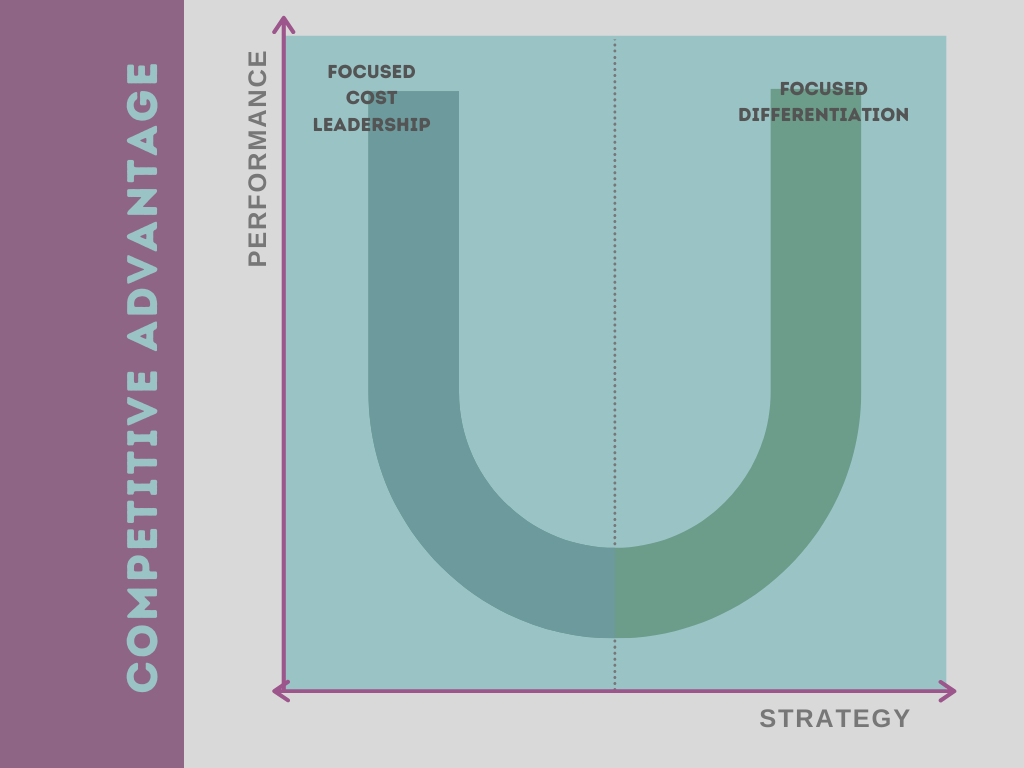
A focus strategy is when a company identifies a specific or narrow target market segment with customers that have different wants and needs in comparison to the overall market segment. Business pursuing a focus strategy will build their products and services to specifically address these customers unique needs. The strategy can be bifurcated into cost-focus or differentiation-focus strategy.
Research has demonstrated that organizations that choose to fully pursue one strategy or the other yields higher performance. This means ensuring that the organization activities align to support either cost leadership or differentiation. Companies that try to organize some activities for cost leadership and comes activities for differentiation tend to produce average performance. This reinforces the need for focus in either or of the strategies.
It is important to note that companies that do not pursue cost leadership still manage their costs and seek efficiencies. The difference is their policies, organizational structure, and leadership ethos promote other ideas such as innovation rather than strict adherence to cost reduction.
Key takeaways
- A competitive advantage happens when an organization owns valuable resources and or capabilities that allows them to perform activities better or for less cost than their rivals.
- The three strategies for competitive advantage are cost leadership, differentiation, and focus.
- Focusing on one strategy allows for above average performance; this means ensuring that leadership, compensation, control systems, and organizational structure are designed to support the chosen strategy.